

A friend, who’d been staying for a few days over Christmas, remarked as she left that she must remember bread, cheese, cucumber and celery provided a perfectly adequate meal. Inevitably, my first thought was “what a lazy host I am”, but my second, more reflective thought was “other people surely eat meals like that too, don’t they?” It seemed not.
I must credit my parents for teaching me the art of minimalist eating – for it truly is an art. Not minimalists in so many other ways – their house is an exquisite cacophony of William Morris prints, half-read old newspapers, overflowing bookshelves and grandchildren’s broken toys, befitting for two retired, hummus-eating, brown-bread-making academics – in the kitchen, they value food pared down. It’s not because they can’t cook or because they shy away from strong flavours. Indeed, both are excellent cooks and are naturally adventurous – in food and all sorts of other things. It’s more that they care about ingredients and that they believe most really, truly, good ingredients are dulled by excessive cooking. (My father prides himself on having distilled his legendary fish pie to fish, tomatoes and a delicate béchamel sauce, which he has refined carefully over many years.)
In my memory, recipe books, though owned, were rarely used – apart from for the odd experimental curry or child’s birthday cake. Evening meals consisted of rice, broccoli and a piece of baked fish; or perhaps a boiled egg, slice of bread and lots of raw vegetables. Fish salad contained nothing more than beautiful fish, brown rice, cucumber, tomatoes and a simple vinaigrette. Carrot salad was carrots, garlic, perhaps mustard, and olive oil. Even Sunday lunch roasts were also on the plain side – a chicken, potatoes, carrots, peas and a light, homemade gravy. Sometimes there would be a crumble, but mostly it would be stewed fruit with plain yoghurt instead.
Of course, we children would complain bitterly at the baked potatoes, steamed cabbage and sausages (they do eat meat, and I did too then), when we knew our friends were eating frozen pizza, lasagne, or at least pasta and sauce. But, that we wolfed every down meal, suggests we didn’t really mind and also, most importantly, that the food in all its minimalist glory was invariably delicious. Money was not abundant, but the ingredients, from the crisp apples in the fruit bowl to the hunk of strong cheese in fridge, were of an excellent quality.
So – perhaps as a result – when I open a recipe book, I am often struck by the bewildering complexity. Dishes, touted as normal food for normal people, require dizzyingly long lists of ingredients, ambidextrous sous chefs and a kitchen better equipped than the Ritz Carlton. Photos are almost too opulent; even a decent attempt on our part will leave us feeling far short of the mark. 30-minute recipe books with their attractive, but misleading, claim are not much better.
The result? Cooking becomes a special event, reserved for weekends, when a morning can be invested in sourcing ingredients, an afternoon in caramelising and marinating, and an evening in devouring and digesting. We’re recipe slaves – flitting between open book and stove, snarling at any interruption, flustered by mishaps and disappointed when the results and reactions are not as desired. “What, you don’t like it?” “I don’t know why I bother.” But, if we don’t present a dish so lavish, we think we’re not really providing a meal at all – which is not true of course.
I love to cook, and, at times, I’m happy to devote a while to preparing a dish – especially if I know it will feed us all for at least three evenings. But mostly the constraints of my life don’t allow it. Tired children, delayed emails, writing ideas half finished, shopping still not done, damp laundry turning mildewed in the machine, I could on. Day in day out, ready meals are not the fix, nor is a takeaway or a tin of soup. So instead, I recall my parents’ approach and mostly dish up the simplest and tastiest food I can find.
And once you know good food unadulterated, it’s hard to go back. What could be better than the first crunch of a fresh carrot, or a bite of pungent cheese offset by dark rye bread.
So whether you work in a busy job, devote yourself to family life, want to become a concert pianist, or precariously balance all three, here are some brief suggestions on eating simply:
1. Good, fresh vegetables don’t need sauces. Cook lightly instead – steam or boil – and only briefly so as to leave a crunch. Add a dab of butter if you really must. If you’re looking for something more luxurious, grate cheese over them, or drizzle on oil olive, sprinkle with salt and add a smidgen of crushed garlic (the adult version). In my experience, children are most likely to eat vegetables when served with nothing at all.
2. Eat plenty of vegetables raw. A chunk of cucumber, half an avocado, a handful of cherry tomatoes, a stick or two of celery, fennel slices if you’re feeling adventurous, a piece of good cheese, and bread or crackers if you need them, is a perfectly balanced and very satisfying meal.
3. On winter evenings, lovely thick soups can be thrown together in a matter of minutes. Just make sure always to have red lentils in the cupboard, and onions and garlic on the side.
4. Poached or baked fish is about as delicious a meal as any. A good fillet of frozen cod or wild salmon, boiled in milk and water for ten minutes, can be used to top any salad, or sit alongside your garlicky vegetables.
5. One slice of dark bread – rye, spelt or wholemeal – is an adequate and speedy accompaniment to any meal.
A scratch meal for two – prepared in five minutes
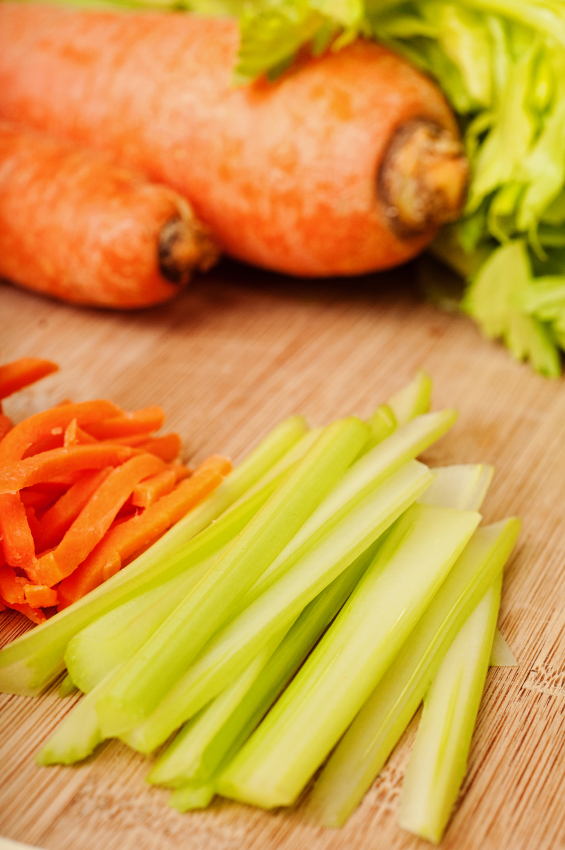
Ingredients
- Good bread (try 100% rye)
- Butter (only if you need it)
- A strong cheese (whatever you prefer)
- 1/3 large cucumber
- 14 cherry tomatoes
- 2 sticks of celery
- 2 carrots
Method
Cut one slice of bread for each person, and butter it (but only if you like it that way – it’s certainly not necessary). You can always go back for more bread if you’re still hungry, but I usually find one is enough – especially in the evening.
Wash all the raw vegetables thoroughly in cold water. Slice the cucumber, and cut the carrots and celery into chunky batons. Assemble the vegetables on one big plate for sharing.
Give each person a couple of sizeable chunks of cheese. Serve.
Alternatives …
- A boiled or poached egg (free range and organic) – two if you’re hungry
- Smoked salmon (wild, organic, with no added sugar)
- Hummus (homemade or good bought stuff – look out for unnecessary ingredients on the back, if it has them, leave it on the shelf!)
- Obviously, any other seasonable vegetable would be welcome on the plate. Experiment – peppers, courgettes, fennel, kohlrabi, broccoli, mushrooms, radishes …
 Of Slender Means
For me, what makes a meal work it the fat content. Plenty of butter on everything makes all sorts of things much better. I cooked a game stew the other day, but I think the fat (and the red wine added) was what made it nice. So I’d expect it was the cheese that makes what you describe here palatable. I’m increasing finding celery too starchy and not flavoursome enough – maybe modern strains put looks over flavour.